
Muscle Memory Typing: The Scientific Way to Learn Fast Typing (Complete Guide)
Have you ever seen people who type at an incredibly fast speed without looking at the keyboard? Their fingers reach the correct keys so easily that it seems as if they already know every letter. Many people think that this is only years of experience or innate talent, but the truth is different. The biggest reason behind this ability is muscle memory typing.
If you want to increase your typing speed in Hindi, English, or any language, you must first understand what muscle memory is and how it is developed. Just memorizing the keyboard buttons does not make someone a fast typist. For fast and accurate typing, regular practice, the right technique, and the development of muscle memory are essential.
In this detailed article, we will learn what muscle memory typing is, how it works, what the scientific ways to develop it are, which mistakes stall your progress, and how you can significantly improve both your typing speed and accuracy in a few months.
What is Muscle Memory
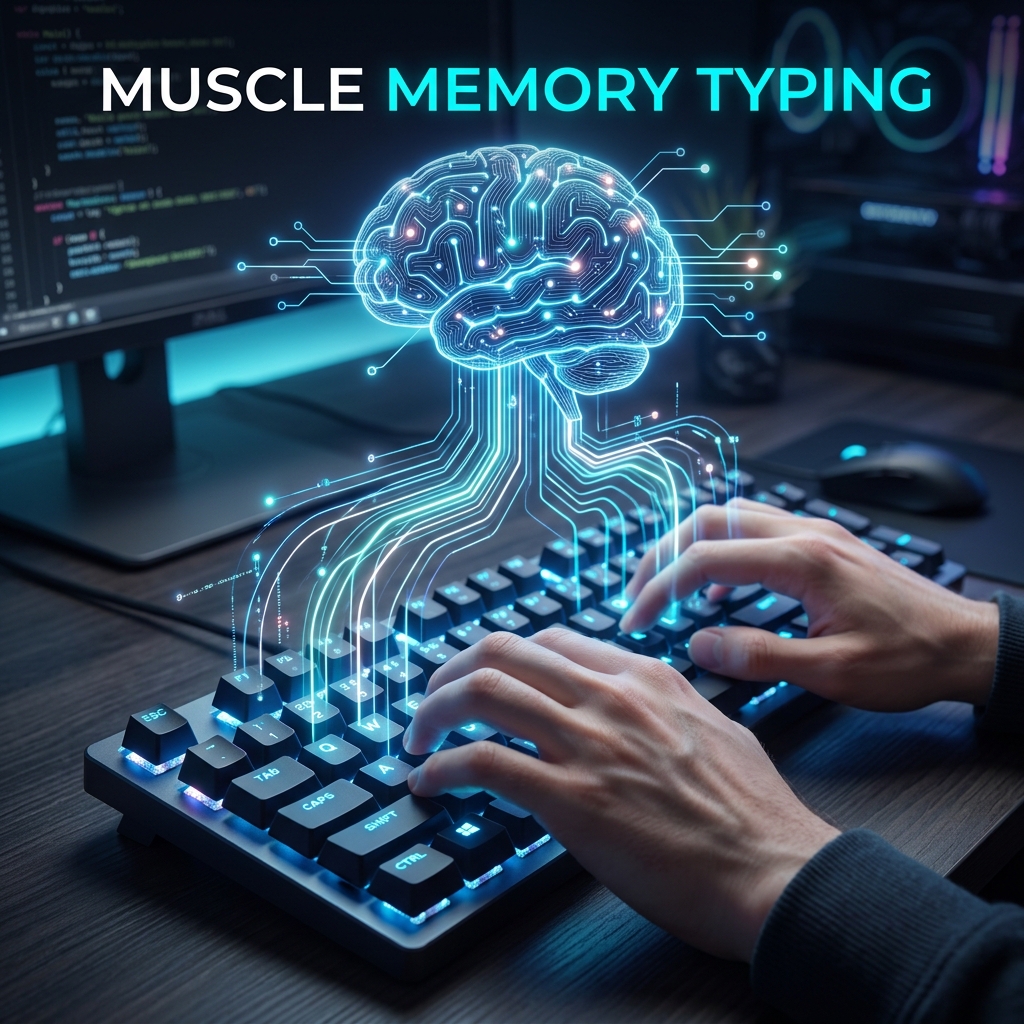
First, it is important to understand that the term muscle memory is a bit misleading. In reality, your muscles do not remember anything. The work of remembering is done by your brain and nervous system.
When you repeat an activity over and over, your brain creates strong neural pathways for that task. This is why, over time, the same task happens without much thought.
This process is commonly known as muscle memory.
During typing, your fingers repeatedly reach the same keys. After some time, the brain learns these movements so well that you do not need to search for each letter.
How Muscle Memory Typing Works
When a person learns typing for the first time, they have to look at the keyboard before typing each letter. The brain first recognizes the letter, then remembers its position, and finally, the finger reaches that key.
This process is slow.
But with regular practice, the situation changes.
Now the brain does not make separate decisions for each letter. As soon as you think of a word, your fingers automatically reach the respective keys.
For example, if you type words like "Bharat" (India), "Sarkar" (Government), "Computer", "Typing" every day, after a few weeks you will hardly have to think to type these words.
This is the real effect of muscle memory typing.
Does Muscle Memory Happen Only in Typing?
No.
Muscle memory develops in almost every activity that involves repeatedly performing similar physical movements.
Additional examples:
In all these tasks, the coordination between the body and the brain improves with practice.
Importance of Muscle Memory in Typing Speed
If your muscle memory is not strong, your typing speed will never permanently increase.
There are several reasons for this:
How Long Does It Take to Build Muscle Memory?
This entirely depends on the individual.
If you practice every day, generally:
* First week: You start understanding the keyboard and memorize the common keys. * 2 to 4 weeks: You form a habit of the home row and begin typing small words without looking. * 1 to 2 months: There is a clear improvement in typing speed and mistakes start to reduce. * 3 to 6 months: Strong muscle memory is developed and touch typing feels quite natural.
If practice is not regular, this time may be longer.
The Best Way to Develop Muscle Memory
Why Muscle Memory is More Important in Hindi Typing
In Hindi typing, there are often conjunct characters, vowel signs (matras), half-letters, and special symbols. These cause difficulties for beginner students.
But as practice increases, the brain starts recognizing these combinations as patterns. Then, conjunct characters like "pra", "tra", "ksha", "gya", "kta", "shra" are also easily typed.
Which Mistakes Can Ruin Your Muscle Memory?
* Incorrect Finger Placement: If you press a key with a different finger every time, the brain gets confused. * Repeatedly looking at the keyboard: This is the most common mistake. It slows down the process of forming muscle memory. * Focusing only on speed: Consistently making mistakes at very high speeds embeds wrong patterns in the brain. * Taking long gaps: If you do not practice for several days, your speed gradually starts to decrease. * Changing techniques every day: Stick to one correct technique. Frequent changes affect the learning process.
30-Minute Daily Practice to Boost Muscle Memory
* First 5 minutes: Home row practice * Next 10 minutes: Common words * Next 10 minutes: Type sentences * Last 5 minutes: Take a speed test and analyze mistakes.
Does Just Taking Speed Tests Build Muscle Memory?
No.
A speed test only tells you your current capability. Muscle memory is built through practice. If you only take tests every day but do not fix your mistakes, improvement will be limited.
The Relationship Between Muscle Memory and Accuracy
Many students only focus on increasing WPM. But if your accuracy is low, the actual productivity will also be low.
Therefore, always:
This is the correct order.
Does Age Have an Impact?
Absolutely not.
Children, college students, job aspirants, and even people over 50 years of age can develop excellent muscle memory with regular practice. The main difference lies only in the regularity of practice.
Importance of Muscle Memory in Competitive Exams
If you are preparing for the following exams:
Then strong muscle memory can significantly increase your chances of success.
Ways to Keep Muscle Memory Strong
* Practice for at least 20 minutes daily. * Take a speed test one day a week. * Type new vocabulary. * Maintain correct sitting posture. * Use both hands equally. * Keep distance from your mobile during practice.
Frequently Asked Questions (FAQ)
Q: Is muscle memory actually in the muscles? No. It is the learning process of the brain and nervous system.
Q: Is it necessary to type without looking at the keyboard? Yes. This habit develops muscle memory the fastest.
Q: How long does it take to form muscle memory? If you practice daily, good improvement is noticeable in 2-6 months.
Q: Is 15 minutes of daily practice enough? Yes. If practiced with correct technique and regularly, 15-30 minutes a day can be very effective.
Q: Should you focus on accuracy before speed? Absolutely. It is difficult to achieve permanent speed without high accuracy.
Conclusion
Muscle memory typing is the most important foundation for learning fast typing. It is no magic, but the result of regular practice, correct finger placement, and consistent repetition. When your brain and nervous system naturally start recognizing the locations of the keys, your fingers reach the right keys without thinking. This is the stage where real touch typing begins.
If your goal is to pass a government typing exam, increase your typing speed for a job, or become proficient in Hindi typing, practice regularly every day, prioritize accuracy, and adopt the right technique. In a few months, you will feel a remarkable improvement in all three—speed, accuracy, and confidence.
Remember, fast typists are not born, they are made through regular and correct practice.