
एमपीईएसबी (MPESB) प्राथमिक एवं माध्यमिक शिक्षक MSPSTET 2026 ऑनलाइन फॉर्म
The Madhya Pradesh Employees Selection Board (MPESB), formerly known as Vyapam, has officially released the highly anticipated notification for the Madhya Pradesh State Primary and Secondary Teachers Eligibility Test (MSPSTET) 2026. This recruitment drive is a monumental opportunity for thousands of candidates aspiring to forge a fulfilling and stable career in the teaching profession within the state government schools of Madhya Pradesh. Becoming a government teacher in Madhya Pradesh not only offers a respectable position in society but also promises a secure future, attractive remuneration, and the profound satisfaction of shaping the minds of the next generation. This comprehensive guide will walk you through every critical aspect of the MSPSTET 2026 examination, from detailed eligibility criteria and syllabus analysis to salary structures and proven preparation strategies.
1. Overview of MSPSTET 2026
The Madhya Pradesh State Primary and Secondary Teachers Eligibility Test (MSPSTET) is a state-level eligibility examination conducted by the MPESB. It is strictly an eligibility test and does not guarantee employment. However, passing this examination with the requisite qualifying marks is an absolute prerequisite for candidates who wish to apply for the posts of Primary Teachers (Varg 3) and Secondary Teachers (Varg 2) in government schools across Madhya Pradesh. The exam acts as a stringent filtering mechanism, ensuring that only those with the right pedagogical knowledge, subject matter expertise, and child psychology understanding step into the classrooms.2. Important Dates
Keeping track of the important dates is the first step toward a successful application process. While specific dates are subject to the official calendar released by MPESB, here is the tentative timeline for the MSPSTET 2026:- Official Notification Release Date: September 2026
- Start Date for Online Application Submission: To be announced
- Last Date for Online Application Submission: To be announced
- Last Date for Fee Payment: To be announced
- Application Correction Window: Typically opens for 3-5 days after the application deadline.
- Admit Card Release Date: Usually 7-10 days before the exam.
- MSPSTET 2026 Examination Date: To be announced
3. Total Vacancies
As an eligibility test, the MSPSTET itself does not advertise a specific number of vacancies. However, clearing this exam qualifies candidates for upcoming recruitment drives conducted by the Department of School Education and the Tribal Welfare Department of Madhya Pradesh. Historically, the state government has announced massive recruitment drives consisting of tens of thousands of vacancies for both Primary and Secondary level teachers to address the shortage of educators in rural and urban districts.4. Eligibility Criteria
Eligibility is the most crucial aspect. Candidates must ensure they meet all educational and age requirements before applying.For Primary Teachers (Varg 3)
- Educational Qualification: Candidates must have passed the Senior Secondary (or its equivalent) examination with at least 50% marks and possess a 2-year Diploma in Elementary Education (D.El.Ed). Alternatively, graduation with a Bachelor of Education (B.Ed) degree is also considered valid, subject to government regulations regarding a bridge course in elementary education.
- Age Limit: The minimum age limit is 21 years. The maximum age limit for General category male candidates is typically 40 years. Age relaxations up to 45 years are applicable for Female candidates, SC, ST, OBC, and PwD candidates as per state government norms.
For Secondary Teachers (Varg 2)
- Educational Qualification: A bachelor's degree in a relevant subject from a recognized university along with a Bachelor of Education (B.Ed) degree or equivalent.
- Age Limit: Minimum 21 years. The upper age limit follows the same structure as that of Primary teachers, heavily favoring reserved categories and female candidates with significant age relaxations.
5. Detailed Job Profile & Responsibilities
The role of a teacher in a government school extends far beyond the traditional boundaries of classroom instruction. It is a multi-faceted job that requires immense dedication, patience, and adaptability.Primary Teachers (Varg 3)
Primary teachers form the bedrock of a child's educational journey. Their responsibilities include:- Foundational Learning: Teaching fundamental concepts in Mathematics, Environmental Studies (EVS), and Languages (Hindi/English). They must ensure that basic literacy and numeracy skills are deeply ingrained in students aged 6 to 11.
- Child Development: Closely monitoring the cognitive, social, and emotional development of young children. They must identify learning disabilities early and adapt their teaching methodologies accordingly.
- Classroom Management: Creating a safe, inclusive, and engaging classroom environment. This involves using interactive teaching aids, games, and storytelling.
- Administrative Duties: Maintaining attendance registers, progress reports, and communicating effectively with parents to discuss student development.
Secondary Teachers (Varg 2)
Secondary teachers handle students in their formative adolescent years, making their role both academically challenging and behaviorally complex.- Subject Specialization: Delivering in-depth knowledge in specific subjects like Mathematics, Science, Social Science, or Languages. They must prepare students for higher academic challenges.
- Lesson Planning and Execution: Designing comprehensive lesson plans, conducting regular assessments, unit tests, and term exams to evaluate student understanding.
- Mentorship: Guiding students through academic and personal challenges, offering career counseling, and helping them navigate the complexities of adolescence.
- Extracurricular Activities: Organizing and supervising school events, science fairs, sports days, and cultural programs to ensure holistic development.
6. Comprehensive Salary Breakdown & Allowances
A career as a government teacher in Madhya Pradesh offers immense financial stability and a lucrative salary structure as per the 7th Pay Commission.Salary Structure
- Primary Teacher (Varg 3): The basic pay typically starts around ₹25,300. After adding various allowances, the gross monthly salary easily ranges between ₹30,000 to ₹35,000 in the initial years.
- Secondary Teacher (Varg 2): The basic pay usually starts at ₹32,800. The gross monthly salary, inclusive of all allowances, ranges between ₹40,000 to ₹45,000.
Detailed Allowances
- Dearness Allowance (DA): This is calculated as a percentage of the basic pay to offset the impact of inflation. The MP government revises this biannually.
- House Rent Allowance (HRA): Depending on the posting (rural vs. urban), HRA varies. Teachers posted in major cities receive a higher HRA compared to those in remote villages.
- Transport Allowance (TA): Provided to cover daily commuting expenses to and from the school.
- Other Benefits: Teachers are entitled to comprehensive medical benefits, maternity and paternity leaves, and a secure retirement plan under the National Pension System (NPS).
7. Career Growth & Promotions Hierarchy
The Department of School Education offers a structured and transparent promotion hierarchy. Teachers who demonstrate dedication, enhance their educational qualifications, and clear departmental examinations can climb the administrative and academic ladder swiftly.
- Primary/Secondary Teacher: The entry-level position.
- Headmaster (Primary/Middle School): Based on seniority and performance, teachers are promoted to lead their respective schools, taking on more administrative responsibilities.
- Principal (High/Higher Secondary School): Further promotions lead to the role of a Principal, overseeing the entire functioning of large educational institutions.
- Block Education Officer (BEO): A significant administrative role where the officer oversees the functioning of all schools within a specific block.
- District Education Officer (DEO): The highest district-level administrative position, responsible for implementing government educational policies and managing the district's entire educational infrastructure.
8. Exam Pattern
Understanding the exam pattern is crucial for strategic preparation. The MSPSTET is conducted in an online, Computer-Based Test (CBT) format.- Type of Questions: Multiple Choice Questions (MCQs).
- Total Questions: 150 questions.
- Total Marks: 150 marks (1 mark per question).
- Duration: 2 hours and 30 minutes (150 minutes).
- Negative Marking: Typically, there is no negative marking in the MSPSTET, encouraging candidates to attempt all questions. However, candidates must verify this in the final official notification.
9. In-depth Syllabus Analysis
Primary Teachers (Paper 1)
The Paper 1 syllabus focuses heavily on child psychology and basic subjects.- Child Development and Pedagogy (30 Marks): This section tests the candidate's understanding of child psychology, theories of learning (Piaget, Vygotsky, Kohlberg), inclusive education, and pedagogical strategies suitable for children aged 6-11.
- Language I (Hindi/English/Sanskrit/Urdu) (30 Marks): Focuses on reading comprehension, unseen passages, grammar, and language pedagogy.
- Language II (30 Marks): Similar to Language I, but evaluates proficiency in a second language chosen by the candidate.
- Mathematics (30 Marks): Covers basic arithmetic (number system, fractions, geometry, measurement, data handling) and pedagogical issues related to teaching math to young learners.
- Environmental Studies (EVS) (30 Marks): Topics include Family and Friends, Food, Shelter, Water, Travel, and the pedagogical aspects of teaching EVS.
Secondary Teachers (Paper 2)
Paper 2 is more advanced and subject-specific.- Child Development and Pedagogy (30 Marks): Focuses on the developmental stages of children aged 11-14, addressing adolescent issues, and advanced pedagogical concepts.
- Language I & II (30 Marks each): Tests language proficiency and pedagogy at a higher difficulty level than Paper 1.
- Subject Specific Section (60 Marks): Candidates must choose their specialization (Mathematics, Science, Social Science, or a specific Language). This section tests deep subject knowledge up to the graduation level and the pedagogy of teaching that specific subject.
10. Preparation Strategy
Cracking the MSPSTET requires a disciplined and targeted approach.- Master the Syllabus: Download the official syllabus and stick to it strictly. Do not waste time on topics not explicitly mentioned.
- Focus on Pedagogy: Pedagogy carries immense weight (up to 90 marks in Paper 1). Understand the theoretical concepts deeply rather than rote memorization.
- NCERT Books are the Bible: For Subject Specific sections, EVS, and Mathematics, completely rely on NCERT textbooks from Class 3 to Class 10.
- Daily Mock Tests: In the last two months, take at least one full-length mock test daily. Analyze your mistakes and work on improving your speed and accuracy.
- Revision Strategy: Create concise, handwritten notes for quick revision in the final weeks before the exam.
11. Recommended Books
- Child Development & Pedagogy: 'Child Development and Pedagogy' by Sandeep Kumar; Disha Experts’ guide for CTET/STET.
- Hindi Language: 'Lucent’s General Hindi' or Aditya Publication's Hindi.
- English Language: 'Objective General English' by S.P. Bakshi.
- EVS & Mathematics: Strictly adhere to NCERT/MP Board textbooks.
- Practice Sets: Kiran Prakashan or Arihant's previous year question papers for MP TET.
12. Previous Year Cut-off Trends & Exam Difficulty
The MSPSTET is a qualifying exam. The qualifying marks are strictly predefined:- General Category: 60% (90 marks out of 150)
- Reserved Categories (SC, ST, OBC, PwD of MP State): 50% (75 marks out of 150)
13. How to Apply
The application process is entirely online.- Visit the official website of MPESB (esb.mp.gov.in).
- Click on the 'Online Form - Primary and Secondary Teacher Eligibility Test 2026' link.
- Register by creating a profile on the MP Online portal (if not already registered).
- Fill out the application form with accurate personal, educational, and contact details.
- Upload scanned copies of your photograph, signature, and necessary educational certificates.
- Pay the application fee through the designated online payment gateway.
- Print the final confirmation page for future reference.
14. Application Fee
- Unreserved (General) Candidates: ₹500 (approximate, subject to change).
- SC/ST/OBC/PwD Candidates (MP Domicile only): ₹250.
15. Selection Process
The selection process for the Eligibility Test is straightforward:- Written Examination (CBT): Candidates must appear for the computer-based test.
- Declaration of Results: MPESB will release the scorecard and qualifying status.
16. Admit Card
The admit card is a mandatory document for entry into the examination hall. It will be released online 7 to 10 days prior to the exam date. Candidates must download it from the MPESB website using their application number and date of birth. It contains crucial details like exam center address, shift timings, and reporting time.17. Result and Certificate Validity
Results will be published on the MPESB website after the normalization process (if the exam is held in multiple shifts). The most significant advantage of clearing the MSPSTET is the certificate validity. Following the NCTE guidelines, the TET qualifying certificate is now valid for a lifetime, removing the burden of retaking the eligibility exam every few years.18. Document Verification
While document verification is not required for appearing in the eligibility test, it is the most critical step during the actual recruitment phase. Candidates must preserve their original mark sheets, degree certificates, B.Ed/D.El.Ed certificates, caste certificates (if applicable), and MP domicile certificates securely.19. Exam Centers
MPESB conducts the examination across all major districts of Madhya Pradesh to ensure accessibility for candidates from rural areas. Prominent exam centers include Bhopal, Indore, Jabalpur, Gwalior, Ujjain, Sagar, Rewa, and Satna. Candidates can state their preference during the application process.20. Contact Information
In case of any discrepancies in the application form or admit card, candidates must immediately contact the MPESB helpdesk:- Official Website: esb.mp.gov.in
- Email Support: Found on the official contact page.
- Helpline Numbers: Available during working hours as listed on the official portal.
21. Frequently Asked Questions (FAQs)
Q: Is the B.Ed degree mandatory for Primary Teachers? A: Yes, B.Ed degree holders are currently eligible for Primary Teacher posts, but they usually have to complete a 6-month bridge course in elementary education after joining.Q: Can candidates from other states apply for MSPSTET? A: Yes, candidates from other states can apply, but they will be considered under the Unreserved (General) category and will not be eligible for age or fee relaxations.
Q: Is there any normalization of marks in MSPSTET? A: Yes, if the exam is conducted across multiple shifts, MPESB applies a mathematical normalization formula to ensure fairness in evaluating the difficulty level across different question papers.
22. Conclusion
The MPESB Primary and Secondary Teachers (MSPSTET) Recruitment 2026 is an incredible gateway to a respected and secure career in the government sector. The syllabus is vast but predictable, and the competition, though fierce, is entirely manageable with a strategic and disciplined approach. Begin your preparation today, focus heavily on child pedagogy and NCERT textbooks, and take regular mock tests. With the right mindset and unwavering dedication, clearing the MSPSTET 2026 and securing a position as a government teacher is a highly achievable goal. Best of luck with your preparation!TypeHindi पर अपनी स्पीड जांचें और अभ्यास करें
SSC CHSL, हाईकोर्ट और क्लर्क भर्ती परीक्षाओं के लिए सटीक WPM और एक्यूरेसी के साथ 10-मिनट टेस्ट दें।
SSC द्वारा अनिवार्य मंगल फॉन्ट पर इनस्क्रिप्ट कीबोर्ड के साथ अभ्यास करें और अपनी स्पीड 30+ WPM बनाएं।
शुरुआती छात्रों के लिए स्टेप-बाय-स्टेप गाइड। होम रो, टॉप रो और मात्राओं पर बिना देखे टाइप करना सीखें।
देवनागरी लिपि के सभी स्वर, व्यंजन, मात्राएं और संयुक्त अक्षरों का सचित्र और स्पष्ट कीबोर्ड मैप।
गिरते हुए शब्दों को तेजी से टाइप करके नष्ट करें और अपनी उंगलियों की रिफ्लेक्स स्पीड को तेजी से बढ़ाएं।
पिटमैन शॉर्टहैंड स्ट्रोक टीचर, एनिमेटेड स्ट्रोक डेमो, वर्ड बिल्डर और 40 से 120 WPM ऑडियो डिक्टेशन।
संबंधित लेख और टाइपिंग गाइड
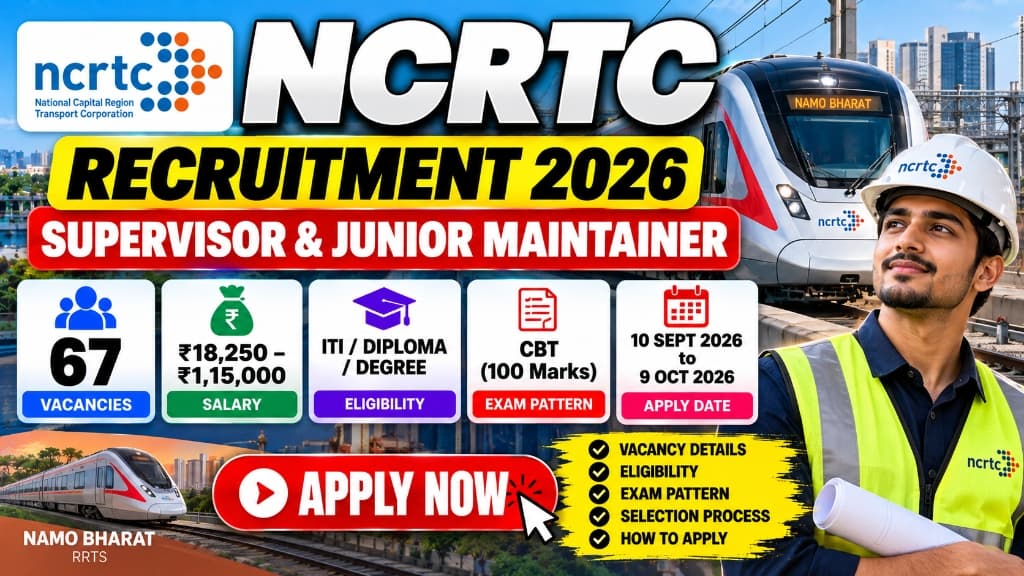
NCRTC Recruitment 2026: 67 Vacancies for Supervisor and Junior Maintainer Posts, Eligibility, Salary, Exam Pattern and How to Apply
The National Capital Region Transport Corporation (NCRTC) has released Vacancy Notice No. 32/2026 for the direct recruitment of Operations & Maintenance staff for the Namo Bharat/RRTS system.
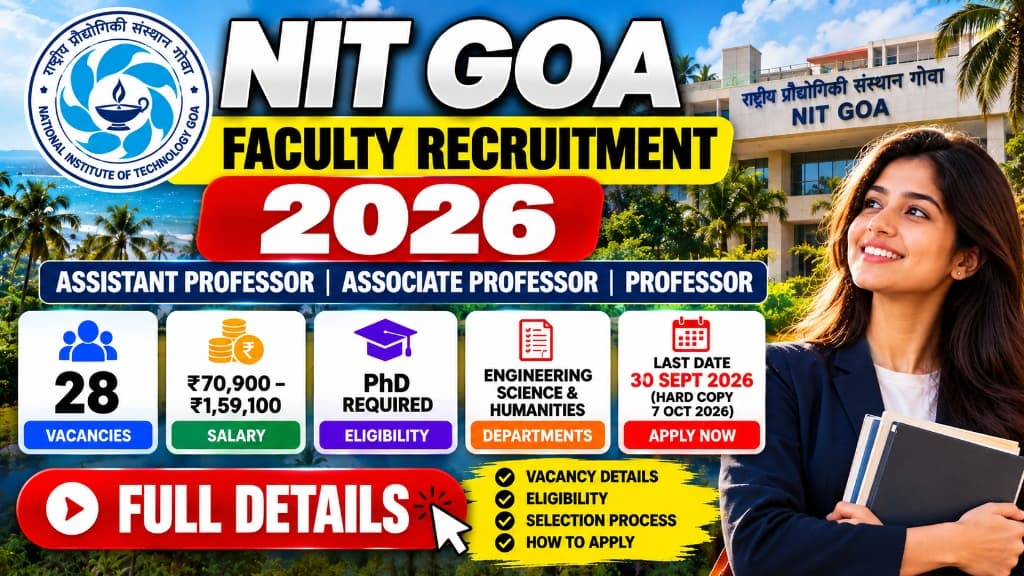
NIT Goa Faculty Recruitment 2026: 28 Posts, Eligibility, Salary, Vacancy, Selection Process and How to Apply
The National Institute of Technology Goa (NIT Goa) has released a notification for the recruitment of faculty members for various departments.
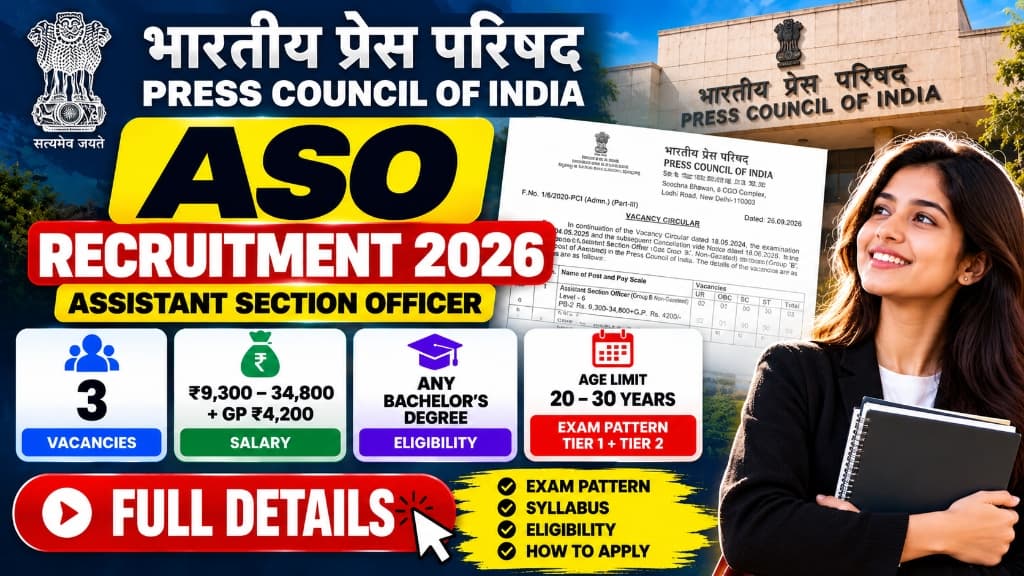
Press Council of India ASO Recruitment 2026: 3 Vacancies, Eligibility, Salary, Exam Pattern, Syllabus and How to Apply
The Press Council of India (PCI) has released a fresh Vacancy Circular 2026 for recruitment to the post of Assistant Section Officer (ASO).
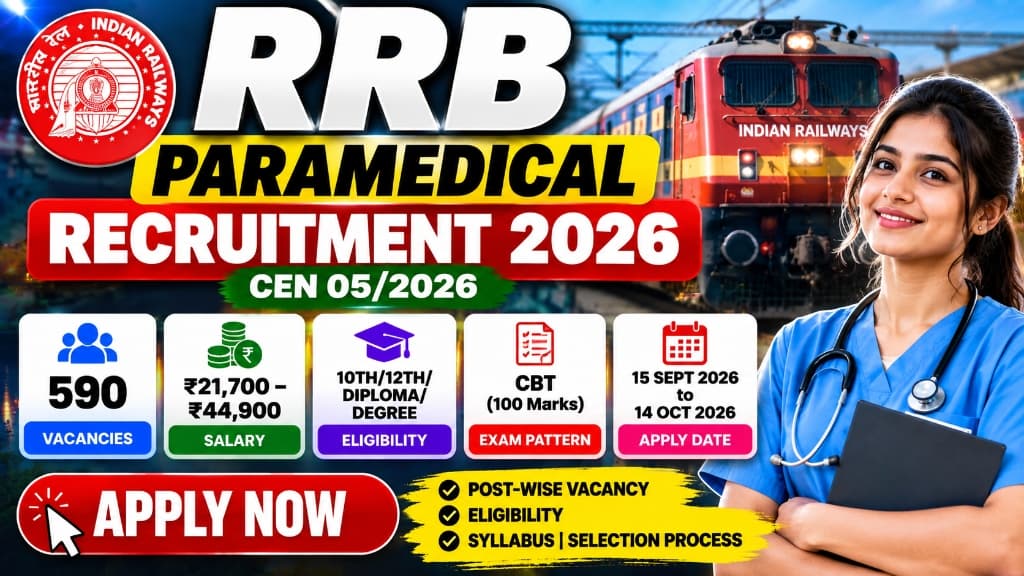
RRB Paramedical Recruitment 2026: 590 Vacancies, Eligibility, Salary, Exam Pattern, Selection Process and How to Apply
The Railway Recruitment Boards (RRBs) have released the RRB Paramedical Recruitment 2026 notification for 590 vacancies. Apply online till 14 October 2026.