
SSC CGL Typing Test Preparation: Complete Guide to DEST, Speed, Accuracy and Practice Strategy
The SSC Combined Graduate Level (CGL) examination is one of India's most competitive recruitment examinations for Group B and Group C government posts. Candidates preparing for SSC CGL usually devote most of their attention to Mathematics, Reasoning, English and General Awareness. However, many candidates underestimate an important qualifying component of Tier-II: the Data Entry Speed Test, commonly known as DEST.
The SSC CGL typing test is different from the traditional typing tests conducted for some other SSC examinations. Candidates are required to demonstrate their ability to enter text accurately on a computer within a specified time. For candidates targeting posts where higher DEST standards apply, proper typing preparation becomes even more important.
According to the SSC CGL 2026 notification, DEST is conducted for 15 minutes in Session-II of Tier-II. Candidates are required to type a passage containing approximately 2,000 key depressions. DEST is mandatory for all posts and is qualifying in nature, although SSC may prescribe higher qualifying standards for certain posts.
This article provides a detailed guide to SSC CGL typing test](/mangal-font-typing-test) preparation, including how DEST works, how to improve typing speed and accuracy, common mistakes, daily [practice routines and a structured preparation strategy.
What Is the SSC CGL Typing Test?
The typing test in SSC CGL is officially called the Data Entry Speed Test (DEST).
Unlike a conventional typing examination where candidates may simply be asked to achieve a particular words-per-minute score, SSC CGL DEST focuses on entering the provided passage on a computer according to the Commission's prescribed evaluation procedure.
The test forms part of SSC CGL Tier-II.
Under the current SSC CGL scheme, Session-II includes the Data Entry Speed Test and lasts for 15 minutes. The test involves a passage of approximately 2,000 key depressions.
Therefore, SSC CGL aspirants should not ignore typing preparation simply because DEST is qualifying in nature.
Failing to meet the qualifying standard can affect eligibility for the relevant stage of selection.
Is SSC CGL DEST Mandatory?
Yes. According to the SSC CGL notification, DEST is mandatory for all posts, although it is qualifying in nature.
This means candidates should treat the typing test seriously.
A qualifying test does not necessarily mean that preparation can be ignored. Candidates must still demonstrate the required level of data-entry ability.
SSC may also set higher qualifying standards for certain posts. The notification specifically mentions posts such as Tax Assistant in CBIC, Tax Assistant in CBDT and UDC/SSA in the Central Bureau of Narcotics, along with certain posts where higher standards of computer proficiency are prescribed.
Therefore, candidates should always check the latest SSC notification and the specific requirements applicable to their preferred posts.
How Does SSC CGL DEST Take Place?
Candidates should understand the examination format before beginning preparation.
During DEST, candidates are required to enter the provided passage on the computer.
The important elements of the current format include:
- DEST is conducted in Tier-II.
- It is conducted during Session-II.
- The duration is 15 minutes.
- The passage contains approximately 2,000 key depressions.
- DEST is mandatory for all posts.
- The test is qualifying in nature.
- Higher qualifying standards may apply to certain posts.
Typing extremely fast while making frequent mistakes is not an effective strategy. Similarly, typing very accurately but extremely slowly may create difficulty in completing sufficient text within the available time.
The goal should be controlled and accurate typing at a comfortable speed.
# Why SSC CGL Aspirants Should Start Typing Practice Early
One of the biggest mistakes candidates make is postponing typing preparation until after completing their written-exam preparation.
Typing is a practical skill.
It cannot always be developed effectively in a few days.
A candidate who practices regularly for several months will generally develop:
- Better keyboard familiarity
- Stronger finger memory
- Improved typing rhythm
- Higher speed
- Better accuracy
- Greater confidence during timed tests
Instead of suddenly trying to increase typing performance shortly before Tier-II, candidates can improve gradually while continuing their regular SSC CGL preparation.
Even 20 to 30 minutes of regular typing practice can produce significant improvement over time.
# Understanding Typing Speed and Accuracy
Typing performance depends mainly on two factors:
Typing Speed
Typing speed refers to how quickly a candidate can enter text.
Candidates often measure their performance in words per minute, commonly known as WPM.
However, SSC CGL DEST should be prepared according to the official examination requirements rather than relying only on a general WPM score.
Different websites may calculate typing speed differently.
Therefore, candidates should focus on:
- Continuous typing ability
- Accuracy
- Completing long passages
- Typing under a time limit
- Maintaining concentration for the entire test
Typing Accuracy
Accuracy is equally important.
A candidate may type quickly but repeatedly make mistakes in:
- Spelling
- Punctuation
- Capital letters
- Numbers
- Spaces
- Word order
Therefore, beginners should initially focus more on accuracy than maximum speed.
Once proper finger placement and keyboard familiarity improve, speed usually increases naturally.
# Speed vs Accuracy: What Should You Prioritize?
The best answer is both, but the order matters.
Beginners should focus first on accuracy.
Trying to type extremely fast before learning correct keyboard technique often creates bad habits.
For example, candidates may:
- Look constantly at the keyboard
- Use only two fingers
- Press incorrect keys repeatedly
- Depend excessively on Backspace
- Lose concentration while typing
Once they consistently achieve good accuracy, they can gradually increase speed.
A practical progression can be:
Stage 1: Learn the keyboard
↓
Stage 2: Improve accuracy
↓
Stage 3: Develop typing rhythm
↓
Stage 4: Increase speed
↓
Stage 5: Practice full 15-minute tests
This approach is generally more effective than immediately chasing a high WPM score.
# Learn Touch Typing for SSC CGL
Touch typing means typing without continuously looking at the keyboard.
This is one of the most useful skills for candidates preparing for DEST.
When candidates constantly look down at the keyboard, they lose time moving their eyes between:
- The passage
- The keyboard
- The computer screen
Initially, learning touch typing can feel slow and uncomfortable.
Candidates may experience a temporary decrease in speed.
However, with consistent practice, muscle memory develops.
Eventually, the fingers begin to remember the location of commonly used keys.
Benefits of Touch Typing
Touch typing can help candidates:
- Type faster
- Maintain concentration
- Reduce unnecessary eye movement
- Improve rhythm
- Type longer passages comfortably
- Perform better under examination pressure
# Proper Typing Posture
Typing preparation is not only about finger speed.
Proper posture can significantly affect comfort during longer typing sessions.
Candidates should try to:
- Sit comfortably with a straight posture
- Keep both feet supported
- Position the keyboard comfortably
- Keep shoulders relaxed
- Avoid excessive wrist strain
- Position the monitor at a comfortable viewing level
Typing should be smooth and controlled.
Candidates preparing for 15-minute continuous typing should develop the ability to remain comfortable throughout the test.
# How to Practice for SSC CGL DEST
The best preparation method is to gradually move from basic typing exercises to realistic timed tests.
Step 1: Learn Keyboard Familiarity
Beginners should first become comfortable with:
- Alphabet keys
- Spacebar
- Shift key
- Enter key
- Backspace
- Full stop
- Comma
- Apostrophe
- Numbers
First learn where the keys are located.
Step 2: Practice Basic Words
Practice common English words repeatedly.
Examples include:
- Government
- Department
- Candidate
- Examination
- Administration
- Information
- Development
- Employment
- Recruitment
Step 3: Practice Full Sentences
After becoming comfortable with individual words, begin typing complete sentences.
Focus on:
- Capital letters
- Spaces
- Full stops
- Commas
- Sentence structure
Step 4: Practice Paragraphs
Move to longer paragraphs.
This improves:
- Concentration
- Typing rhythm
- Endurance
- Accuracy
Step 5: Take Timed Tests
Finally, begin taking full-length practice tests.
Candidates preparing for SSC CGL should regularly practice continuous typing sessions similar to the 15-minute DEST duration prescribed in the current notification.
# The Best Daily Practice Routine
A structured daily practice session can be more useful than random typing.
Here is a practical routine.
Five Minutes: Warm-Up
Start with simple words and sentences.
Do not immediately begin at maximum speed.
The purpose is to:
- Relax your fingers
- Improve rhythm
- Prepare your hands
Ten Minutes: Accuracy Practice
Type carefully.
Focus on avoiding mistakes.
Pay attention to:
- Incorrect letters
- Missing spaces
- Double spaces
- Punctuation mistakes
- Capitalization errors
Ten Minutes: Speed Practice
Take a timed typing test.
Try to maintain a comfortable rhythm.
Do not rush unnecessarily.
Ten Minutes: Error Analysis
Review your mistakes.
Ask yourself:
- Which letters do I frequently press incorrectly?
- Do I struggle with punctuation?
- Do I make mistakes with capital letters?
- Do I lose concentration after several minutes?
- Do I repeatedly use the wrong finger?
Fifteen Minutes: Full DEST-Style Practice
Take one continuous typing test.
Practice without:
- Pausing
- Checking your phone
- Taking unnecessary breaks
- Restarting after mistakes
# Common Typing Mistakes SSC CGL Aspirants Should Avoid
Looking at the Keyboard Constantly
This slows down typing.
Try to gradually reduce keyboard dependence.
Typing Too Fast
Speed without control often leads to mistakes.
Maintain a comfortable rhythm.
Using Only Two Fingers
Two-finger typing may work for casual computer use, but it can limit long-term improvement.
Learning better finger positioning can significantly improve typing efficiency.
Ignoring Punctuation
Many candidates practice only simple words.
During actual typing, punctuation and capitalization can interrupt rhythm.
Practice them regularly.
Practicing Only Short Tests
Typing for two minutes is very different from typing continuously for fifteen minutes.
SSC CGL candidates should regularly practice longer sessions.
Panicking After One Mistake
One mistake does not mean the entire test is ruined.
Continue calmly.
Candidates often make more mistakes after becoming nervous about an earlier error.
# How to Improve Typing Speed
Typing speed improves gradually.
There is no reliable shortcut that instantly transforms a beginner into a fast typist.
However, these methods can help.
Practice Every Day
Consistency is more important than occasional long practice sessions.
For example:
30 minutes daily
can be more effective than:
Three hours once a week
Regular repetition builds muscle memory.
Practice Difficult Words
Identify words that slow you down.
For SSC preparation, practice longer formal words such as:
- Administration
- Government
- Examination
- Recruitment
- Qualification
- Organization
- Information
- Department
- Development
- Communication
Improve Weak Keys
If you repeatedly make mistakes with particular letters, practice them separately.
For example, if certain combinations cause difficulty, create short exercises containing those combinations.
Maintain Rhythm
Smooth typing is generally better than repeatedly accelerating and stopping.
Try to maintain a steady rhythm.
# How to Improve Accuracy
Accuracy requires deliberate practice.
Candidates can improve accuracy by:
- Typing slightly slower initially
- Reading carefully
- Maintaining concentration
- Practicing difficult words
- Reviewing mistakes
- Using proper finger placement
Suppose you repeatedly type a particular word incorrectly.
Instead of hoping the mistake disappears automatically, practice that word repeatedly.
Targeted practice produces faster improvement.
# Practice Different Types of Passages
Do not practice only simple typing content.
SSC CGL aspirants should become comfortable with different styles of English.
Practice passages containing:
- Government-related vocabulary
- Formal English
- Long words
- Numbers
- Dates
- Punctuation
- Capital letters
# Build Typing Endurance
DEST requires continuous typing.
A candidate who can type quickly for two minutes may still struggle to maintain concentration for fifteen minutes.
Therefore, typing endurance is important.
Gradually increase practice duration.
For example:
Week 1: 5-minute tests
Week 2: 8-minute tests
Week 3: 10-minute tests
Week 4: 15-minute tests
Once comfortable, regularly practice full-duration tests.
# A 30-Day SSC CGL Typing Preparation Plan
Days 1 to 7: Build the Foundation
Focus on:
- Keyboard familiarity
- Proper finger positioning
- Accuracy
- Basic English words
Days 8 to 14: Develop Speed
Begin:
- Timed typing
- Longer words
- Sentences
- Punctuation practice
Days 15 to 21: Improve Consistency
Practice:
- Longer passages
- Numbers
- Capital letters
- Difficult vocabulary
Days 22 to 30: DEST-Focused Preparation
Practice full 15-minute typing sessions.
Analyse every test.
Focus on your weaknesses.
By the final week, your goal should be consistency rather than experimenting with completely new typing techniques.
# How to Track Your Progress
Maintain a simple typing progress record.
You can write down:
| Day | Typing Speed | Accuracy | Major Mistakes |
|---|
| ------ | ------------: | ------------: | ------------------------ |
|---|
| Day 1 | Record result | Record result | Identify weakness |
|---|
| Day 7 | Record result | Record result | Compare improvement |
|---|
| Day 15 | Record result | Record result | Identify repeated errors |
|---|
| Day 30 | Record result | Record result | Evaluate readiness |
|---|
Tracking performance helps candidates understand whether they are improving.
Do not judge your preparation based on a single test.
Look at your overall progress over several weeks.
# What to Do During the Actual SSC CGL DEST
During the examination:
Read Instructions Carefully
Do not assume that every typing test follows exactly the same procedure.
Follow the instructions provided for the examination.
SSC states that detailed instructions regarding the skill test may be provided by the relevant Regional Offices, and the Commission determines the manner in which DEST is conducted.
Stay Calm
Nervousness can affect typing rhythm.
Take a moment to settle before beginning.
Focus on Accuracy
Do not immediately type at maximum speed.
Establish a comfortable rhythm.
Do Not Panic After Mistakes
Continue typing.
Avoid losing concentration because of a single error.
Manage the Entire Fifteen Minutes
The goal is consistent performance throughout the test.
Do not exhaust yourself during the first few minutes by typing uncontrollably fast.
# Final Tips for SSC CGL Typing Test Preparation
- Start typing preparation early.
- Understand the official DEST format.
- Practice regularly.
- Focus on accuracy before maximum speed.
- Learn touch typing gradually.
- Practice punctuation and capitalization.
- Take continuous 15-minute practice tests.
- Analyse repeated mistakes.
- Practice formal English passages.
- Maintain proper posture.
- Do not panic during the examination.
- Always check the latest SSC notification for official requirements.
The SSC CGL Data Entry Speed Test may be qualifying in nature, but candidates should not underestimate its importance. According to the current SSC CGL notification, DEST is mandatory for all posts and is conducted for 15 minutes using a passage of approximately 2,000 key depressions. Higher qualifying standards may apply to certain posts.
The best way to prepare is through regular and structured practice.
Start by learning the keyboard properly. Focus on accuracy. Gradually improve speed. Practice longer passages and eventually take full 15-minute mock typing tests.
Remember that typing is a practical skill.
You do not need extraordinary speed on your first day. Consistent practice builds muscle memory, confidence, accuracy and endurance over time.
With proper preparation, regular practice and a calm approach during the examination, SSC CGL aspirants can become much more confident about facing DEST.
TypeHindi पर अपनी स्पीड जांचें और अभ्यास करें
SSC CHSL, हाईकोर्ट और क्लर्क भर्ती परीक्षाओं के लिए सटीक WPM और एक्यूरेसी के साथ 10-मिनट टेस्ट दें।
SSC द्वारा अनिवार्य मंगल फॉन्ट पर इनस्क्रिप्ट कीबोर्ड के साथ अभ्यास करें और अपनी स्पीड 30+ WPM बनाएं।
शुरुआती छात्रों के लिए स्टेप-बाय-स्टेप गाइड। होम रो, टॉप रो और मात्राओं पर बिना देखे टाइप करना सीखें।
देवनागरी लिपि के सभी स्वर, व्यंजन, मात्राएं और संयुक्त अक्षरों का सचित्र और स्पष्ट कीबोर्ड मैप।
गिरते हुए शब्दों को तेजी से टाइप करके नष्ट करें और अपनी उंगलियों की रिफ्लेक्स स्पीड को तेजी से बढ़ाएं।
पिटमैन शॉर्टहैंड स्ट्रोक टीचर, एनिमेटेड स्ट्रोक डेमो, वर्ड बिल्डर और 40 से 120 WPM ऑडियो डिक्टेशन।
संबंधित लेख और टाइपिंग गाइड

NCRTC Recruitment 2026: 67 Vacancies for Supervisor and Junior Maintainer Posts, Eligibility, Salary, Exam Pattern and How to Apply
The National Capital Region Transport Corporation (NCRTC) has released Vacancy Notice No. 32/2026 for the direct recruitment of Operations & Maintenance staff for the Namo Bharat/RRTS system.

NIT Goa Faculty Recruitment 2026: 28 Posts, Eligibility, Salary, Vacancy, Selection Process and How to Apply
The National Institute of Technology Goa (NIT Goa) has released a notification for the recruitment of faculty members for various departments.
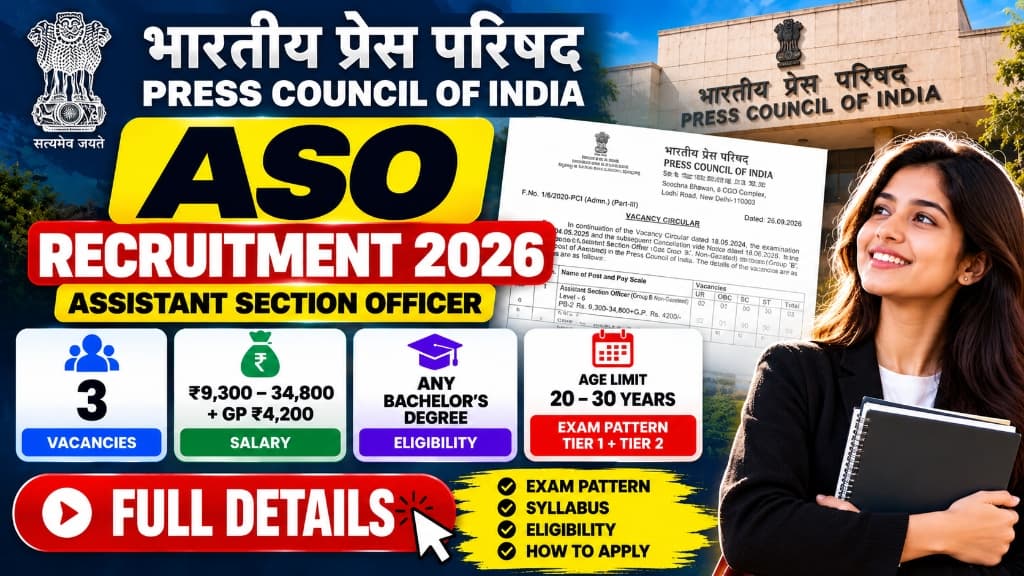
Press Council of India ASO Recruitment 2026: 3 Vacancies, Eligibility, Salary, Exam Pattern, Syllabus and How to Apply
The Press Council of India (PCI) has released a fresh Vacancy Circular 2026 for recruitment to the post of Assistant Section Officer (ASO).

RRB Paramedical Recruitment 2026: 590 Vacancies, Eligibility, Salary, Exam Pattern, Selection Process and How to Apply
The Railway Recruitment Boards (RRBs) have released the RRB Paramedical Recruitment 2026 notification for 590 vacancies. Apply online till 14 October 2026.